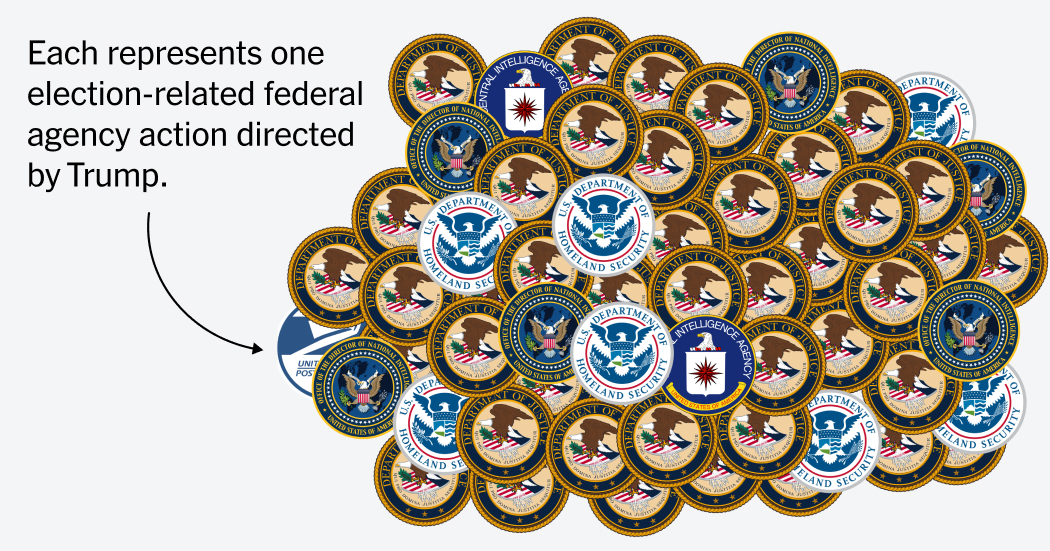
Each represents one election-related federal agency action directed by TrumpEach represents one election-related federal agency action directed by Trump President Trump is trying to use the levers of the federal government, along with personal influence over state and local lawmakers, to reshape the rules governing the 2026 midterms and future elections in extraordinary ways.Many of these efforts have been blocked by courts, stymied by the Constitution or stopped in Congress. But the relentless assault by the president on the electoral process — both administratively and rhetorically — is likely to sow doubt and lay groundwork for extensive challenges to election results.Agencies and officials across the federal government have, at the direction of Mr. Trump, undertaken dozens of actions grounded in novel strategies and aimed at insulating Republicans from potential losses in November. Those actions fall into six major categories (and some fall into more than one). Jump to a section Taking steps to nationalize electionsTrying to tighten voting restrictionsPushing for mid-decade redistrictingCutting election securityUndermining faith in the electoral system by questioning previous resultsPunishing those who have worked against election denialism Taking steps to nationalize elections Issued proposed rule to control mail-in ballotsFiled lawsuits against Utah and other states for failing to produce voter registration listsJustice DepartmentAt least 14 actionsD.H.S.U.S.P.S.Justice DepartmentD.H.S.U.S.P.S.Issued proposed rule to control mail-in ballotsAt least 14 actionsFiled lawsuits against Utah and other states for failing to produce voter registration lists The United States Constitution puts control over elections in the hands of the states and grants Congress the ability to pass federal election legislation. It gives no explicit authority to the executive branch.But in early February, Mr. Trump said he wanted the Republican-led federal government to “nationalize” or “take over” the running of elections. “A state is an agent for the federal government in elections,” he said.Mr. Trump had already, in March 2025, signed an executive order seeking broad authority over elections. The order required documentary proof of citizenship to register to vote and mandated the return of mail ballots by Election Day. Those were almost universally blocked by courts, which found that the order clearly violated the separation of powers and exceeded the president’s authority.But another provision, which instructed the U.S. attorney general to hunt for and prosecute election crimes, has been used to justify sprawling efforts by the Justice Department related to elections.The Justice Department began demanding the complete voter files — state databases of registered voters that include sensitive personal identifying information — from every state as it worked to compile the largest set of national voter roll data it has ever collected.More than half the states — many under Democratic control but some run by Republicans, too — have resisted this effort. In response, the Justice Department has sued at least 30 states and territories, seeking to force them to turn over their unredacted voter rolls. At least 16 states have provided or indicated an intention to turn over their lists, according to tracking from the Brennan Center for Justice. Election workers sorting mail-in ballots in Phoenix during the presidential primary election in March 2024. Rebecca Noble for The New York Times In January, Pam Bondi, then the attorney general, requested that Minnesota turn over its voter rolls to “bring back law and order” amid protests against the Trump administration’s immigration crackdown. Minnesota officials dismissed the request as “outrageous.”Though the Justice Department has yet to win a single lawsuit — it has lost at least 10 so far, as well as one federal appeal — election officials and Democrats fear the battle over voting records may be used in a pos
Fuente: NYT — Ver nota original