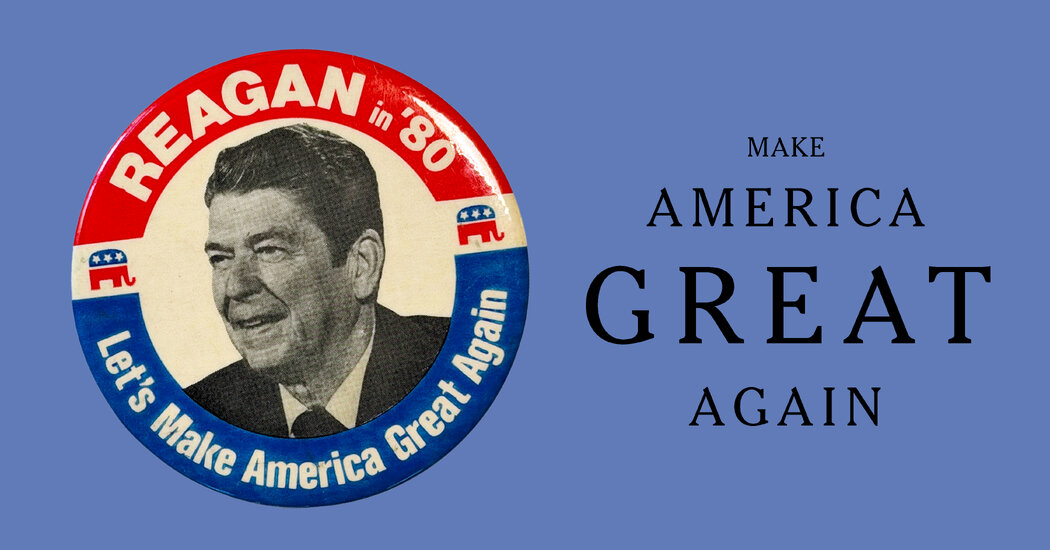
America, One Line At a Time The United States was written into being. Now, 250 years after the Declaration of Independence, we look at six sentences that shaped the American story — taken from a founding document, an incendiary speech, a classic autobiography, an inaugural address, a protest song and a baseball cap. By A.O. Scott A.O. Scott is a Times critic who writes about literature and ideas. June 8, 2026 Share full article4Yes, it’s a campaign slogan, an ideological catchphrase, a monument of political branding rather than rhetorical art. Some readers may wince at seeing these four words in a collection of important American sentences; others may suspect trolling or trickery. But it’s hard to deny the impact of this declaration, which predates the 2016 presidential election and resonates beyond the outrage cycles of the past decade.Unpack the MAGA acronym, detach the words from the person of Donald Trump (who was not the first presidential candidate to invoke them) and you find a sentiment nearly as old as the Republic itself. Some versions of the national story see American history as an epic of progress, bending toward a future that will redeem the injustices of the past. These four words evoke a persistent and powerful counternarrative of loss, decline and betrayal. They look to the past to redeem the failures of the present. Make America Great Again The genius of “Make America great again” as a motto is that it captures this sense of tragedy without specifying its source, linking the longing for a blurry past with an equally abstract call to action. The words are freighted with dog whistles and deniability, directed at implied enemies, but they distill those grievances into a blunt and stirring challenge.In 1980, the Reagan campaign printed buttons that said “Let’s Make America Great Again” — a statement of collective intention, a thing the citizens of the Republic might all pitch in to accomplish together.In 1991, announcing his candidacy, Bill Clinton echoed this notion, saying, “I believe that together we can make America great again.”In the 21st-century baseball cap edit, the grammar has shifted from Reagan’s subjunctive and Clinton’s first person to Trump’s imperative.This isn’t a wish or a suggestion; it’s an order.But who is issuing the command, and who is supposed to carry it out? Is this the language of a sovereign instructing his people? Or is it the reverse — a populace rallying its would-be leader?It’s both and neither. Unlike Reagan’s slogan or Clinton’s revision of it, Trump’s mantra is less a statement of shared duty than a mutual evasion of responsibility. Whoever says “Make America great again” is logically and grammatically counting on someone else to do the job.What is the job, though? Shifting the focus from grammar to semantics reveals a fresh set of complications. Each of the last three words opens a can of worms. What is America? How is it great? When was the before implied in “again”?Nostalgia isn’t the exclusive property of the political right, but the structure of feeling that underlies much of modern American conservatism can be found in the impulse to restore something essential that has been lost.In 1982, the year after Reagan’s inauguration, Merle Haggard released the single “Are the Good Times Really Over (I Wish a Buck Was Still Silver),” which would rise to No. 2 on the Billboard country charts. The song, a somber and defiant anthem laced with Haggard’s characteristic irony, is a succinct compendium of anti-progressive cultural complaints. Merle Haggard and Ronald Reagan in 1982. Bettmann/Getty Images The lyrics conjure a time before Elvis Presley and the Beatles, when “coke was still cola and the joint was a bad place to be.” Along with drugs and rock ’n’ roll (and maybe also paper currency), came an erosion of traditional gender roles and responsibilities. In the old days, “a man could still work and still would” and “a girl could still cook and still would.” You get the picture.
Fuente: NYT — Ver nota original